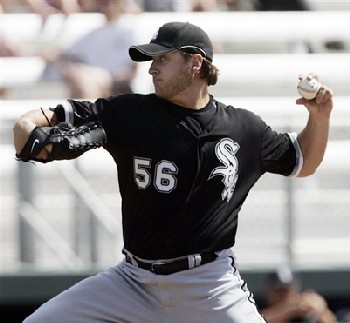
Image courtesy of http://www.chrisoleary.com
So the folks who run the MLB are sticklers about their copyright privileges, so I can't embed the video on the blog, so you'll have to click on the link below. The video shows one of the best plays of all time by White Sox pitcher Mark Buehrle. The audio from two television and two radio broadcasts is played during the video.
http://www.mlb.com/video/play.jsp?content_id=7285867
When describing an event a radio commentator has to speak differently than one on television. The audio commentary is obviously more important for the radio broadcast because it is the only way for the information transfer to occur. Unlike radio, television broadcasts do not always require the audio commentary. In fact, I often enjoy watching tennis matches and hockey games without the commentary.
The jobs of radio play-by-play men and color commentators are significantly different than their television counterparts because they have to tell listeners what is happening in more detail and set the mood of the game.
You can hear differences in the audio feeds of the multiple radio broadcasts and the single television broadcast. Initially I noticed that what was said was different. On the radio the commentators are the mechanism for observing the game, so they gave a literal play-by-play of the action, expressing every aspect of the play as detailed as they could. This was in contrast to the play on TV where nothing was said until the ball bounced of the foot of Buehrle and the announcers sensed that something spectacular was going to happen. Even then, their exclamations were less detailed than the radio announcers. Perhaps this is because they have less experience expressing the game verbally. They seemed to rely on the replay to relay the significance of the play rather than their explanation it. In both broadcasts I understood how incredible the play was immediately just from the excitement of the announcers, but I didn't understand exactly what happened until the replay was shown on TV. The television announcers could have been hesitant to speak to quickly out of fear that they might be shown to be wrong by the replay. It's also possible that I should have been able to pick up on the play on my own, and my lack of baseball knowledge prevented me from seeing the obvious.
Obviously the televised broadcast had video, which the radio could not have. One radio commentator mentioned that we should check out "the highlights" after the game. Humans rely on sight as their primary sense, which is why most people prefer to watch baseball on TV rather than listen on the radio. It's much more difficult to verbally explain what is happening in a game than to show video of it. Watching a 500ft home run on live TV is much easier to understand than listening to an announcer call it on the radio. One has to be familiar with the layout of the field, positions and baseball terminology in order to follow a game on the radio. These are not a challenge for a baseball fan, but a baseball novice can quickly enjoy and begin to understand a game by watching it on TV.
Another obvious plus for the video is instant replay. The first time I saw the play I didn't realize that Buerhle threw the ball with his glove between his legs, and I still thought it was a good play. After I saw the replay I was even more impressed because I had seen it in super slow-mo and could easily see how ridiculous the play was.
There are those who do enjoy a radio broadcast more than a televised game. The radio announcer has a greater opportunity to work the emotions of the listener because he is more of a storyteller, while a television announcer takes on the role of a narrator by filling in gaps and focusing the viewer on specific plays and players. When listening to the radio broadcasts I could feel the excitement much more tangibly than when I watched the play on TV. The announcers still definitely let me know that Buehrle's play was something special, but I didn't feel emotional in any way. Overall the radio announcer has much more power over the audience than the television announcer because he path for information to travel, while there are two paths for the televised game.

First of all: BOO! This play was made against my Cleveland Indians, which means that while I appreciated it I could not enjoy it.
ReplyDeleteAs to the TV vs. Radio sportscasting dilemma: I think that we have to give it up for the radio guys. They work hard, they can't lag, and, if they're good, they can ALMOST make the fan see the play unfold. Radio sportscasting is an art.
On the other hand, TV permits the instant replay. The play in question here doesn't even look spectacular until you see it from angle #3. In this way, TV does more than radio to immortalize certain great plays.
So it's six of one, half dozen of the other. I'm happy that sporting events are still broadcast in both forums.